Hydrogen Battery Breakthrough: A New Path for Clean Energy Storage
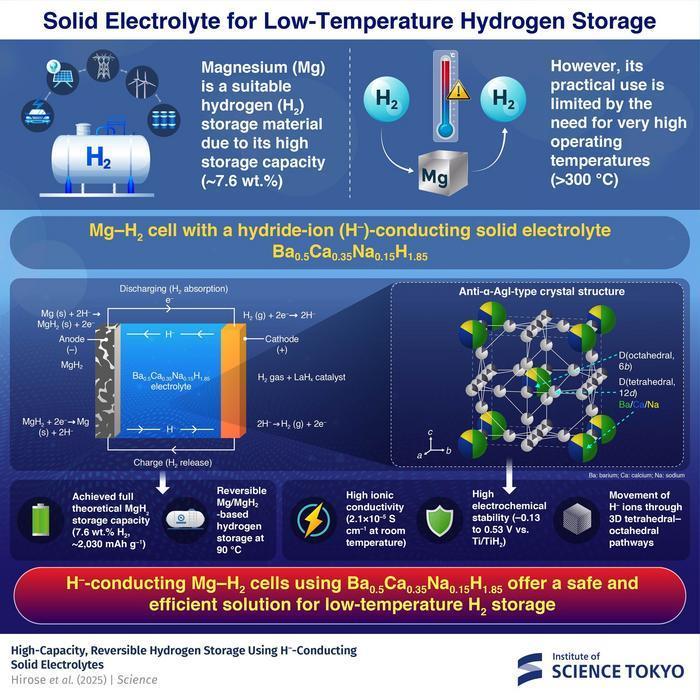
Hydrogen has long been hailed as a cornerstone of the clean energy transition, but safely and efficiently storing it remains a formidable challenge. Conventional methods demand either extremely high pressures, cryogenic temperatures, or both — all of which add cost and complexity. A new study led by Naoki Matsui and Ryoji Kanno at the Institute of Science Tokyo may change that. Their team has developed a solid-state electrolyte that allows hydrogen storage via electrochemical reactions at far milder conditions, opening the door to practical “hydrogen batteries.”
The researchers designed an electrolyte made from a barium–calcium–sodium hydride compound (BaH₂–CaH₂–NaH). Thanks to its body-centered cubic (bcc) crystal structure, the material provides open channels for hydride ion movement and demonstrates unusually high ionic conductivity. In test cells, the new system successfully enabled hydrogen storage and release at just 90°C — far below the 300°C often required with conventional metal hydrides such as MgH₂ or LiH.
Electrochemical Hydrogen Storage: Revisiting an Old Idea
The concept of electrochemical hydrogen storage dates back to the pioneering work of Robert Huggins at Stanford University in the 1980s. He proposed that hydride ions could be inserted into metals electrochemically, but the lack of suitable electrolytes kept the idea on the sidelines. The breakthrough achieved by Matsui and Kanno lies in creating a stable, superionic solid electrolyte that makes this approach finally viable.
In experiments using magnesium hydride (MgH₂) anodes and LaHx cathodes, their system operated reliably over multiple cycles, demonstrating the theoretical storage capacity of MgH₂. As independent expert Genki Kobayashi of RIKEN commented, this represents “an important milestone” and could mark the turning point toward new devices that exploit hydrides for efficient energy storage.
Why This Matters for the Energy Transition
Hydrogen is often described as the “fuel of the future” because it can store renewable electricity in chemical form and release it on demand without carbon emissions. However, technical hurdles — including storage density, cost, and safety — have slowed its widespread adoption. By enabling storage through electrochemical reactions at moderate temperatures, this new approach could provide a practical, scalable solution for stationary storage, grid balancing, and fuel-cell technologies.
Beyond energy storage, solid-state hydrogen batteries could integrate with next-generation renewable systems, offering a way to buffer intermittent sources like wind and solar. Moreover, using hydrides as electrochemical media avoids the need for compressed gas tanks or cryogenic infrastructure, simplifying logistics and improving safety.
Next Steps in Research
Matsui and Kanno’s team plans to further optimize both electrolytes and electrode materials, aiming for even higher ionic conductivity and lower operating temperatures. Their research highlights the importance of crystal chemistry in enabling breakthrough energy technologies. By fine-tuning ion pathways and leveraging the polarizable nature of certain cations, they are paving the way for devices that are efficient, stable, and scalable.
📄 Original source: Chemistry World — Hydrogen battery relieves the pressure for clean energy storage (October 2025).
🔬 Reference: T. Hirose et al., Science, 2025, 389, 1252. DOI: 10.1126/science.adw1996
This article on Quantum Server Networks was prepared with the assistance of AI technologies for content structuring and background research.
Sponsored by PWmat (Lonxun Quantum) – a leading developer of GPU-accelerated materials simulation software for cutting-edge quantum, energy, and semiconductor research. Learn more at https://www.pwmat.com/en.
📘 Download our company brochure: PWmat PDF Brochure
🎁 Try PWmat for free: Request a Free Trial

📞 Phone: +86 400-618-6006
📧 Email: support@pwmat.com
#HydrogenStorage #HydrogenBattery #CleanEnergy #SolidStateElectrolytes #EnergyTransition #GreenHydrogen #MaterialScience #RenewableEnergy #QuantumServerNetworks #Innovation #SustainableTech


Comments
Post a Comment