The Maximum Tc of Conventional Superconductors at Ambient Pressure
Published on Quantum Server Networks
The quest to understand the limits of superconductivity has been one of the central challenges in condensed matter physics for more than a century. Since Heike Kamerlingh Onnes first observed superconductivity in mercury in 1911 at 4.2 K, scientists have pursued higher critical temperatures (Tc) that could unlock transformative applications in quantum computing, magnetic levitation, lossless power transmission, and high-field magnets.
A new article published in Nature Communications (link to original article) takes a comprehensive look at the theoretical upper limits of conventional superconductors at ambient pressure. Conventional superconductivity, described by the Bardeen–Cooper–Schrieffer (BCS) theory and its Eliashberg extension, arises from electron-phonon coupling, where vibrations in a crystal lattice enable electrons to form Cooper pairs. The study analyzes over 20,000 compounds through high-throughput computational methods and machine learning, offering one of the most extensive evaluations of superconducting potential to date.
Key Findings of the Study
The research highlights an intrinsic trade-off: materials with high phonon frequencies (which tend to boost Tc) generally exhibit weaker electron-phonon coupling constants (λ), while those with stronger λ values usually have lower phonon frequencies. This balance prevents the realization of an “ideal” Eliashberg spectral function that could yield room-temperature superconductivity at ambient pressure.
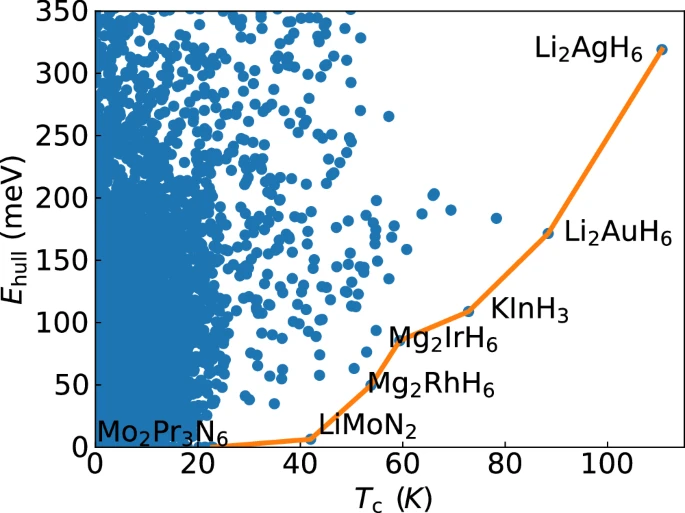
Among the most promising candidates identified are Li2AgH6 and Li2AuH6, both predicted to have Tc values exceeding 100 K under ambient pressure conditions. Importantly, these transition temperatures surpass the benchmark of liquid nitrogen (77 K), which could make them practical for real-world technologies. However, the study notes that these compounds are thermodynamically unstable, making experimental synthesis and stabilization a formidable challenge.
Why Room-Temperature Superconductivity Remains Elusive
While prior estimates suggested that conventional superconductors might reach Tc values between 300–600 K, this latest analysis suggests that such expectations are overly optimistic. The fundamental relationship between λ and phonon frequencies implies that even the best candidates plateau at around 100–120 K. This is far higher than the 39 K transition temperature of MgB2—currently the record-holder among conventional superconductors at ambient pressure—but still well below the coveted room-temperature regime.
Furthermore, compounds with the highest predicted Tc values were also found to be thermodynamically unstable and far from the convex hull of stability. This instability strongly suggests that synthesizing such materials under practical conditions is extremely unlikely without extreme measures such as high-pressure synthesis followed by quenching.
The Bigger Picture: Superconductivity Beyond the Conventional
This work reinforces a sobering but important conclusion: room-temperature superconductivity at ambient pressure via conventional electron-phonon mechanisms is highly improbable. Still, the dream of practical room-temperature superconductors remains alive, but likely through unconventional mechanisms (e.g., high-Tc cuprates or iron-based superconductors), exotic pairing interactions, or innovative pathways such as pressure-induced metastable phases.
The results also emphasize the growing power of computational materials discovery. Leveraging machine learning and high-throughput ab initio simulations, the authors screened more than 100 million potential compounds, narrowing the field to the most promising candidates. Such large-scale computational approaches are reshaping how materials science tackles grand challenges.
Conclusion
The findings presented in this study underscore the importance of setting realistic expectations in the search for high-Tc superconductors. While the physical laws of electron-phonon coupling do not impose an absolute ceiling, the practical barriers make ambient, room-temperature superconductivity in conventional systems an extremely unlikely outcome. Nevertheless, identifying compounds like Li2AgH6 and Li2AuH6 provides valuable insight into the boundary conditions of superconductivity, guiding future research toward unconventional mechanisms and experimental innovations.
This blog article was prepared with the help of AI technologies to ensure clarity, depth, and readability.
Sponsored by PWmat (Lonxun Quantum) – a leading developer of GPU-accelerated materials simulation software for cutting-edge quantum, energy, and semiconductor research. Learn more about our solutions at: https://www.pwmat.com/en
📘 Download our latest company brochure to explore our software features, capabilities, and success stories: PWmat PDF Brochure
🎁 Interested in trying our software? Fill out our quick online form to request a free trial and receive additional information tailored to your R&D needs: Request a Free Trial and Info

📞 Phone: +86 400-618-6006
📧 Email: support@pwmat.com
Citation: Gao, K., Cerqueira, T. F. T., Sanna, A., Fang, Y.-W., Dangić, Đ., Errea, I., Wang, H.-C., Botti, S., & Marques, M. A. L. (2025). The maximum Tc of conventional superconductors at ambient pressure. Nature Communications. https://www.nature.com/articles/s41467-025-63702-w
#Superconductivity #MaterialsScience #QuantumComputing #EnergyInnovation #CondensedMatterPhysics #HighTc #BCSTheory #MachineLearningMaterials


Comments
Post a Comment