Machine Learning Meets Materials Science: Unlocking Discovery with 120 Million Atomic Configurations
In recent years, machine learning (ML) has become a powerful tool for accelerating scientific discovery across physics, chemistry, and materials science. Yet, one of its biggest bottlenecks has been the availability of reliable, standardized datasets for training accurate and transferable interatomic potentials. A new breakthrough addresses this challenge: the introduction of LeMat-Traj, a unified dataset containing over 120 million atomic configurations, designed to revolutionize materials modeling and computational discovery.
A Unified Dataset for Materials Research
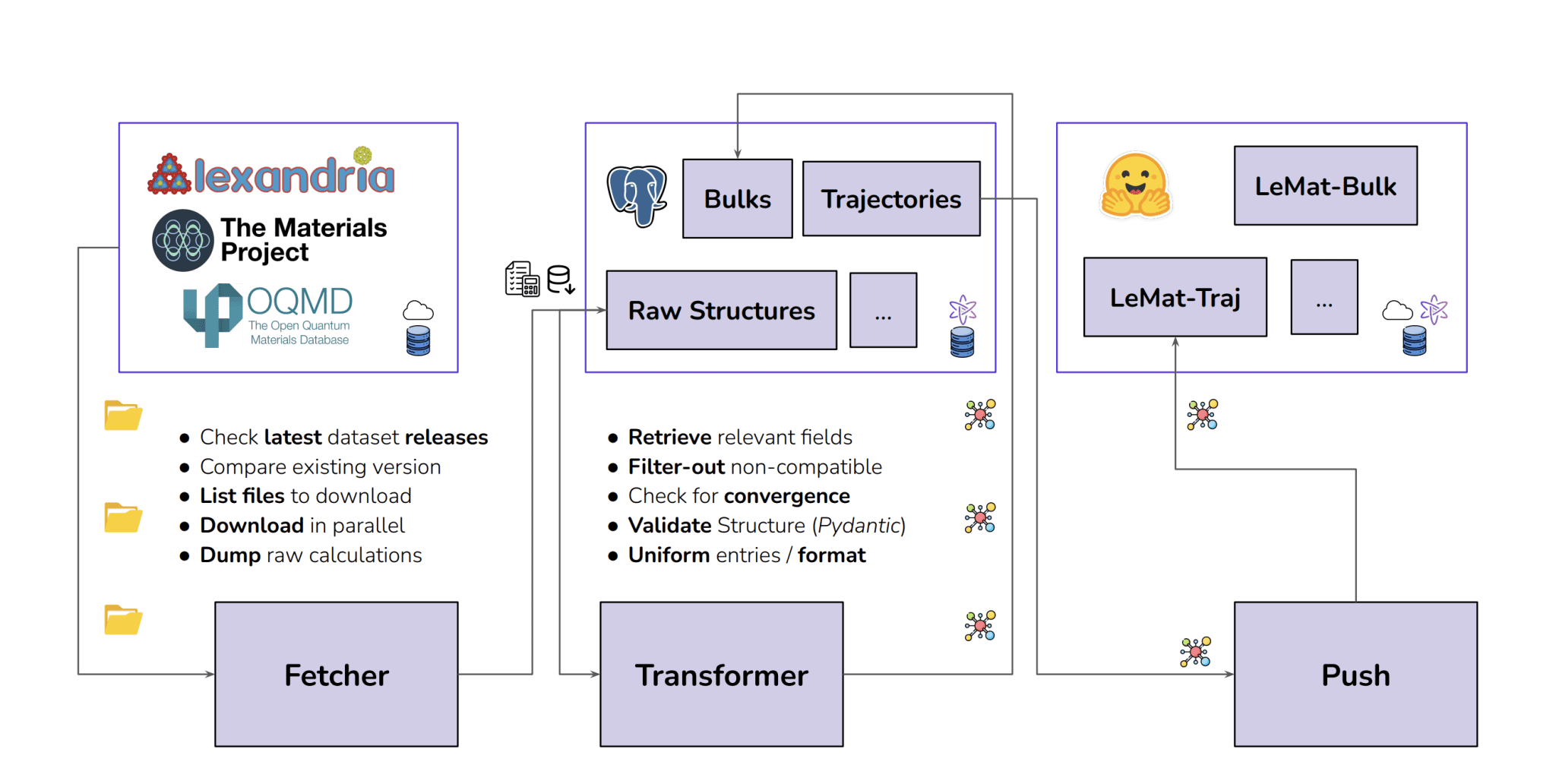
Developed by researchers at Entalpic, including Ali Ramlaoui, Martin Siron, and Inel Djafar, LeMat-Traj consolidates data from major repositories such as the Materials Project, Alexandria, and OQMD. By standardizing data formats and ensuring consistency across different Density Functional Theory (DFT) methods, this initiative provides researchers with a large-scale, high-quality resource for building better machine learning models.
Unlike fragmented datasets, LeMat-Traj covers both stable configurations and high-energy states, offering a comprehensive view of potential energy landscapes. This diversity makes it invaluable for developing ML models that can generalize beyond narrow conditions—an essential step toward universal interatomic potentials.
Boosting Machine Learning Accuracy
Experiments show that fine-tuning existing ML models with LeMat-Traj significantly improves their predictive accuracy. For example, force prediction errors in relaxation tasks were reduced by more than 36%, while performance on the Matbench Discovery benchmark improved by over 10%. Such advances could dramatically accelerate the pace of materials design and discovery.
LeMat-Traj also addresses a key gap: the low-force regime, which is crucial for accurate geometry optimization and structural predictions. By densely sampling states near equilibrium as well as high-energy configurations, it enables models to better capture the subtleties of material behavior during relaxation pathways.
LeMaterial-Fetcher: Expanding the Future of Datasets
To ensure the dataset’s longevity, the team also developed LeMaterial-Fetcher, an open-source library that automates data collection, validation, and transformation from multiple sources. This framework makes it easier for the community to expand and maintain the dataset, ensuring that machine learning in materials science can continue to scale alongside new discoveries.
This combination of LeMat-Traj and LeMaterial-Fetcher not only strengthens the reproducibility of computational materials research but also creates a foundation for multi-fidelity learning and self-supervised learning techniques.
Implications for Materials Discovery
The launch of LeMat-Traj underscores how critical standardized data is for the next generation of AI-driven materials discovery. By bridging gaps between disparate repositories and providing a reproducible data pipeline, the initiative could accelerate breakthroughs in fields ranging from battery materials and semiconductors to catalysts and quantum materials.
This milestone highlights the transformative synergy of machine learning and materials science, showcasing how large-scale datasets can unlock previously unreachable scientific horizons.
Original article source: Quantum Zeitgeist
Prepared with the assistance of AI technologies to enhance readability and SEO performance.
Sponsored by PWmat (Lonxun Quantum) – a leading developer of GPU-accelerated materials simulation software for cutting-edge quantum, energy, and semiconductor research. Learn more at: https://www.pwmat.com/en
📘 Download our latest company brochure: PWmat PDF Brochure
🎁 Try our software: Request a free trial and tailored information here: Free Trial Request

📞 Phone: +86 400-618-6006
📧 Email: support@pwmat.com
#MachineLearning #MaterialsScience #ArtificialIntelligence #InteratomicPotentials #MaterialsDiscovery #BigData #QuantumServerNetworks #DFT #ComputationalMaterials #AIforScience


Comments
Post a Comment