AI-Powered Lab Assistant CRESt Accelerates Materials Discovery at MIT
Published on: September 26, 2025
Original Source: MIT News Article
🤖 CRESt: A Smarter Way to Discover Materials
In a major step forward for AI-driven science, researchers at MIT have unveiled a groundbreaking platform called CRESt — short for Copilot for Real-world Experimental Scientists. The system combines natural language processing, robotic automation, vision-language models, and literature mining to autonomously run complex experiments and optimize materials discovery.
In a paper published in Nature, the MIT team demonstrated that CRESt could plan and conduct thousands of electrochemical tests across more than 900 chemistries, ultimately discovering a record-breaking fuel cell catalyst using formate salts — a cheaper and more sustainable alternative to precious metals.
🔬 The Problem with Traditional Materials Science
Designing new materials for batteries, fuel cells, and other technologies is labor-intensive, often requiring months or years of trial-and-error. Human researchers must design experiments, run tests, analyze results, and iterate based on intuition and scattered literature references.
Even AI tools used in materials science typically rely on single data streams and simplistic models. That’s where CRESt breaks new ground — incorporating multimodal data such as:
- Scientific literature
- Chemical compositions
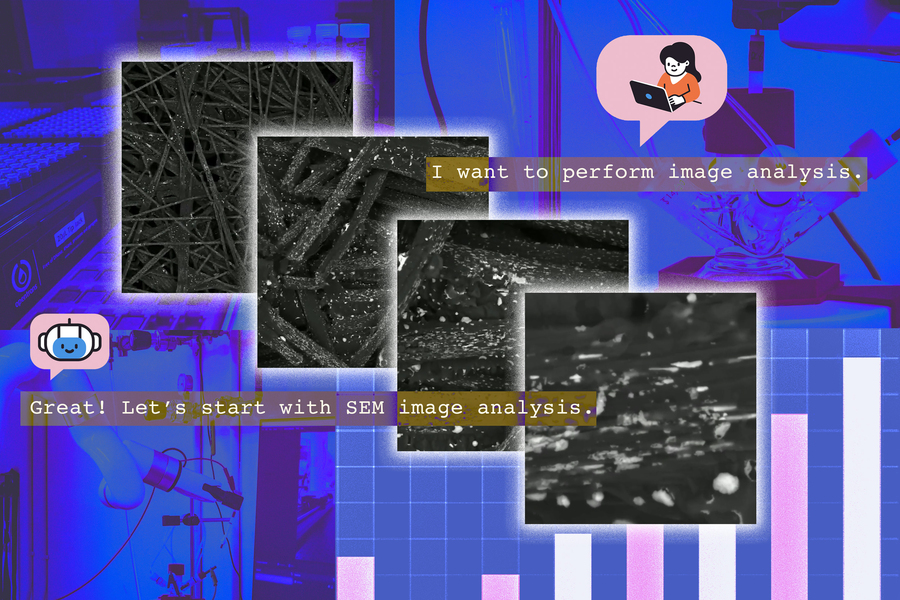
- Microscopy images (SEM, XRD, etc.)
- Live robotic experiment feedback
- Human voice/text interactions
⚙️ How CRESt Works
Powered by large language models and connected to a suite of robotic instruments, CRESt functions like a true lab assistant — one that never sleeps. Researchers can interact with CRESt using natural language, asking it to design new materials, evaluate literature, or troubleshoot experimental anomalies.
The system uses Bayesian optimization and active learning to explore new material recipes, searching through reduced design spaces generated from literature-based embeddings. Cameras monitor reactions in real time, and image analysis algorithms identify potential issues in pipette handling, sample shape, or synthesis conditions.
🔋 Real-World Breakthrough: Fuel Cell Catalyst Discovery
CRESt was recently tasked with finding a low-cost, high-efficiency catalyst for a direct formate fuel cell. In just three months, it:
- Tested 900+ chemistries
- Conducted 3,500 electrochemical tests
- Discovered a multielement catalyst that delivered a 9.3x boost in power-per-dollar vs. palladium
This represents a record in catalyst performance — achieved using only one-fourth the precious metal content of previous devices. It’s a remarkable proof-of-concept that CRESt can solve long-standing materials engineering problems faster and more cost-effectively than traditional methods.
🧠 CRESt is a Copilot, Not a Replacement
While CRESt can automate many steps, the researchers are quick to point out that human scientists remain essential. “CRESt is an assistant, not a replacement,” says MIT Professor Ju Li. “It explains its hypotheses, suggests next steps, and helps researchers make better decisions — much like a colleague with encyclopedic memory and tireless precision.”
As scientific discovery becomes more data-intensive and interdisciplinary, systems like CRESt could become foundational in tomorrow’s self-driving labs, reducing cost, improving reproducibility, and accelerating innovation across disciplines from energy to quantum computing.
📖 Scientific Reference
"AI system learns many types of scientific information and runs experiments, discovering new materials" – MIT News, September 25, 2025.
🔗 Read the full article on MIT News
This blog article was prepared with the assistance of AI technologies for content generation and formatting.
Sponsored by PWmat (Lonxun Quantum) – a leading developer of GPU-accelerated materials simulation software for cutting-edge quantum, energy, and semiconductor research. Learn more about our solutions at: https://www.pwmat.com/en
📘 Download our latest company brochure to explore our software features, capabilities, and success stories: PWmat PDF Brochure
🎁 Interested in trying our software? Fill out our quick online form to request a free trial and receive additional information tailored to your R&D needs: Request a Free Trial and Info

📞 Phone: +86 400-618-6006
📧 Email: support@pwmat.com
#AIMaterialsDiscovery #MITCRESt #BayesianOptimization #ActiveLearning #SelfDrivingLabs #FuelCellCatalyst #MaterialsScience #AIinScience #QuantumServerNetworks #HighThroughputExperimentation


Comments
Post a Comment