Probing the Limits of Multimodal AI in Chemistry and Materials Science
Artificial intelligence has made remarkable progress in recent years, moving beyond text-only tasks into the realm of multimodal reasoning, where models process and connect both images and text. For chemistry and materials science—fields that rely heavily on visual data such as spectra, crystal structures, and experimental set-ups—this represents a major opportunity. But how capable are today’s models in handling these challenges?
A new study published in Nature Computational Science introduces MaCBench, a benchmark designed to evaluate vision-language models (VLLMs) in real-world chemistry and materials tasks (read the full article here). The work highlights both the promise and the limitations of current systems, offering valuable guidance for the future of AI-driven research assistants.
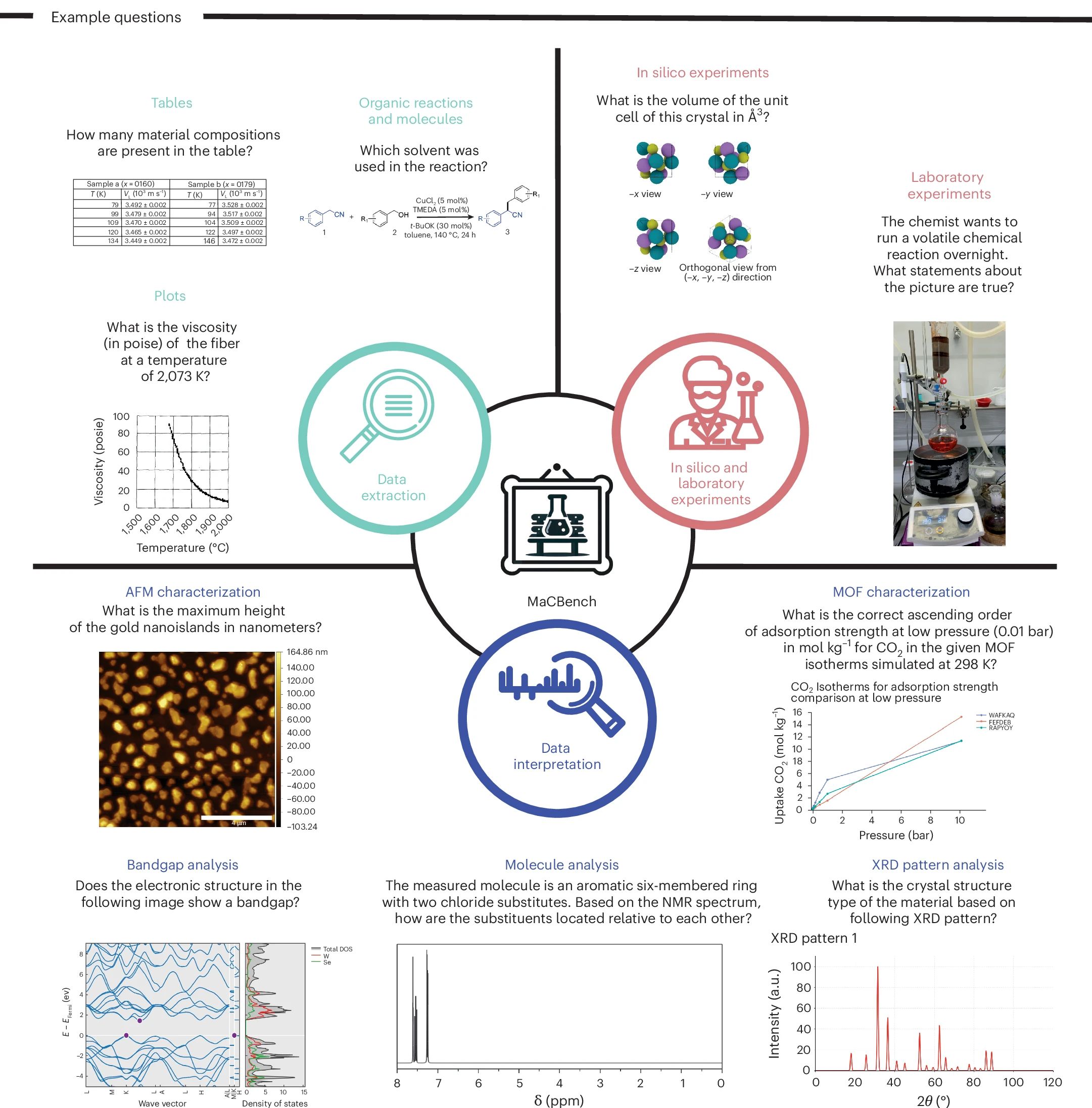
Figure: Overview of the MaCBench framework used to evaluate AI models across chemistry and materials science workflows. (Credit: Nature Computational Science)
Why Multimodal AI Matters for Materials Research
Traditional scientific workflows demand integrating diverse forms of data—spectroscopic signals, microscopy images, experimental setups, and published literature. Human researchers seamlessly combine these information streams to design experiments and interpret results. Current large language models (LLMs), while powerful in text reasoning, lack the ability to natively handle these multimodal challenges.
This is where vision-language models come into play. They promise to revolutionize research by interpreting lab images, extracting data from graphs, and even reasoning about safety conditions. Imagine an AI assistant that can not only read a journal article but also parse the X-ray diffraction (XRD) pattern included in its figures. The potential is transformative, but the latest study shows that we are not quite there yet.
The MaCBench Benchmark
The researchers behind MaCBench structured their evaluation into three pillars of scientific workflows:
- Data extraction – parsing tables, plots, and reaction diagrams from literature.
- Experimental execution – identifying laboratory equipment, assessing safety scenarios, and recognizing crystal structures.
- Data interpretation – analyzing spectra, electronic structures, and materials characterization outputs such as XRD or AFM images.
Across more than 1,100 tasks, leading VLLMs like Claude 3.5 Sonnet, GPT-4o, Gemini 1.5 Pro, and Llama 3.2 90B Vision were evaluated. Results revealed clear strengths but also systemic weaknesses: while models performed near-perfectly in recognizing laboratory equipment or extracting numbers from simple plots, they struggled with spatial reasoning, cross-modal synthesis, and multi-step inference. For example, some models could locate the strongest peak in an XRD pattern but failed to correctly rank relative intensities—a critical step for real scientific interpretation.
Core Limitations Identified
Through ablation studies, the team identified several recurring limitations:
- Spatial reasoning – models failed at stereochemistry and crystal system assignments.
- Cross-modal integration – performance was consistently higher when information was presented as text rather than as an image.
- Multi-step reasoning – accuracy dropped sharply when tasks required chained logical steps.
- Terminology sensitivity – even minor changes in scientific vocabulary influenced performance.
Perhaps most strikingly, model success correlated with the frequency of scientific concepts on the internet, suggesting reliance on pattern matching rather than true scientific reasoning. This finding raises important questions about how future AI systems should be trained to achieve deeper understanding.
Implications for the Future
The message from this study is clear: while multimodal AI tools can already support researchers in specific tasks, they are not yet reliable co-pilots for complex scientific reasoning. For chemistry and materials science, the path forward may require generating synthetic training datasets, developing better cross-modal integration strategies, and designing architectures capable of robust spatial reasoning.
As self-driving laboratories and autonomous discovery pipelines become more common, the need for trustworthy multimodal AI will only grow. The MaCBench study provides not only a diagnostic of current limitations but also a roadmap for building the next generation of scientific assistants.
This article is based on the research paper: Nawaf Alampara et al., “Probing the limitations of multimodal language models for chemistry and materials research,” Nature Computational Science (2025). Available here.
Footnote: This blog article for Quantum Server Networks was prepared with the help of AI technologies.
Sponsored by PWmat (Lonxun Quantum) – a leading developer of GPU-accelerated materials simulation software for next-generation quantum, energy, and semiconductor research. Learn more about their solutions at: https://www.pwmat.com/en
📘 Download the latest company brochure to explore software features, capabilities, and success stories: PWmat PDF Brochure
🎁 Interested in trying PWmat? Request a free trial and receive tailored information for your R&D needs: Request a Free Trial

📧 Contact: support@pwmat.com
#ArtificialIntelligence #MaterialsScience #QuantumServerNetworks #ChemistryResearch #VisionLanguageModels #AIinScience #Nanotechnology #MachineLearning #ScientificDiscovery


Comments
Post a Comment