PFAS-Free Batteries: The Next Frontier in Sustainable Energy Storage
“Forever chemicals”, officially known as PFAS (per- and polyfluoroalkyl substances), have become a major focus of regulatory and environmental scrutiny. Used for decades in countless industrial and consumer products due to their exceptional stability and resistance to heat and chemicals, PFAS are now known to persist in the environment and accumulate in living organisms, causing significant health concerns. Linked to cancer, immune system disorders, and developmental problems, PFAS are widely regarded as a global environmental threat.
Until recently, the battery industry has largely flown under the radar of PFAS regulation. But as the demand for Li-ion batteries grows—driven by the boom in electric vehicles and renewable energy storage—attention is shifting to their reliance on PFAS-based materials. A new report by IDTechEx, “Additives for Li-ion Batteries and PFAS-Free Batteries 2026-2036”, reveals both the scale of the challenge and the growing momentum toward a PFAS-free future.
Why PFAS Are Used in Batteries
PFAS compounds are highly effective in battery applications due to their chemical stability, conductivity, and adhesion properties. They are used extensively in:
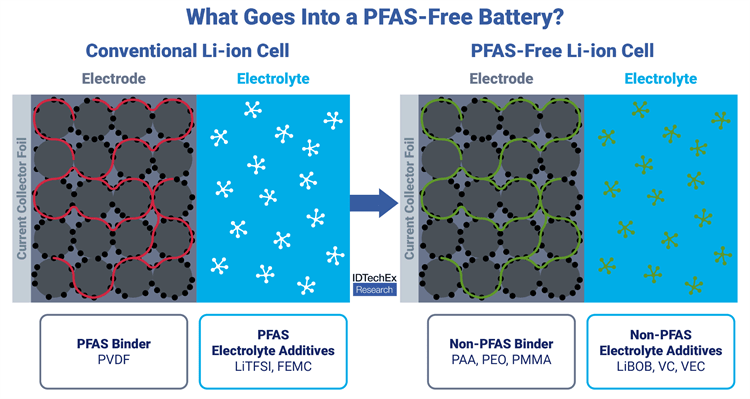
- Binders: PVDF (polyvinylidene fluoride), a PFAS material, is the dominant binder in Li-ion cathodes. As electrode production moves toward dry manufacturing, PVDF is often replaced by PTFE, another PFAS polymer.
- Electrolyte additives: PFAS-based salts and carbonates enhance conductivity, improve stability, and can even function as flame retardants.
While these roles are technically indispensable today, the environmental persistence of PFAS has prompted researchers and manufacturers to urgently seek alternatives.
The Push for PFAS-Free Alternatives
The IDTechEx report highlights promising developments in PFAS-free binders and electrolytes. For binders, companies like Leclanché have already removed PFAS from their systems. Alternatives include synthetic and bio-based polymers such as polyacrylic acid (PAA) and polyethylene oxide (PEO). Other innovators, including Nanoramic and 24M, are developing binder technologies that move beyond polymer-based solutions entirely.
On the electrolyte side, startups like E-Lyte have announced PFAS-free electrolyte formulations. Non-PFAS additives such as lithium bisoxalatoborate (LiBOB) and vinylene carbonate (VC) are already gaining traction in commercial cells, with more specialized non-PFAS additives under development.
A Market Ready for Disruption
According to IDTechEx, the market for non-PFAS battery additives is expected to exceed US$2 billion by 2036. This growth will be fueled by the dual pressures of regulatory crackdowns and industry demand for sustainable, high-performance alternatives. Early adopters of PFAS-free technologies are likely to secure competitive advantages in both EV manufacturing and grid-scale storage.
The path toward PFAS-free batteries is not straightforward. Direct substitution is rarely possible due to the highly specific chemistry of electrolyte formulations and electrode fabrication. Instead, progress will come from novel materials design, advanced polymers, and alternative chemistries tailored to meet the demanding performance requirements of Li-ion technology.
The Road Ahead
The transition away from PFAS will be one of the most significant material transformations in the battery industry over the next decade. By benchmarking key players, analyzing patents, and tracking commercialization efforts, the IDTechEx report provides a roadmap for how the industry can align with stricter environmental standards while ensuring continued technological progress.
You can read the full article on AZoM here: https://www.azom.com/news.aspx?newsID=64821
*This blog article was prepared with the assistance of AI technologies.*
Sponsored by PWmat (Lonxun Quantum) – a leading developer of GPU-accelerated materials simulation software for cutting-edge quantum, energy, and semiconductor research. Learn more about our solutions at: https://www.pwmat.com/en
📘 Download our latest company brochure to explore our software features, capabilities, and success stories: PWmat PDF Brochure
🎁 Interested in trying our software? Fill out our quick online form to request a free trial and receive additional information tailored to your R&D needs: Request a Free Trial and Info

📞 Phone: +86 400-618-6006
📧 Email: support@pwmat.com
Keywords: PFAS-free batteries, lithium-ion batteries, PFAS alternatives, sustainable energy storage, battery additives, non-PFAS binders, non-PFAS electrolytes, IDTechEx report, EV batteries, environmental materials science


Comments
Post a Comment