Revolutionizing Solar Panels: New Composite Material Enables Passive Cooling in Harsh Climates
Solar panels are a cornerstone of the global transition to renewable energy, yet they still face significant performance limitations—especially in extreme environments like the Middle East. Now, researchers at King Abdullah University of Science and Technology (KAUST), in collaboration with King Abdulaziz City for Science and Technology (KACST), have unveiled a composite material that passively cools solar cells, boosting their efficiency and lifespan. The results were recently published in Materials Science and Engineering: R and featured by AZoCleantech.
The Challenge: Heat Is the Enemy of Solar Cells
In desert environments such as Saudi Arabia, solar panels often overheat, reducing their ability to convert sunlight into electricity. While high-efficiency solar cells can theoretically achieve over 25% power conversion efficiency, real-world conditions—including heat and dust—dramatically lower that figure. Traditional active cooling systems like fans and pumps consume energy themselves, making them counterproductive in some cases. That's why passive cooling technologies have become a hot topic—pun intended—in solar research.
KAUST’s Breakthrough: A Humidity-Responsive Cooling Film
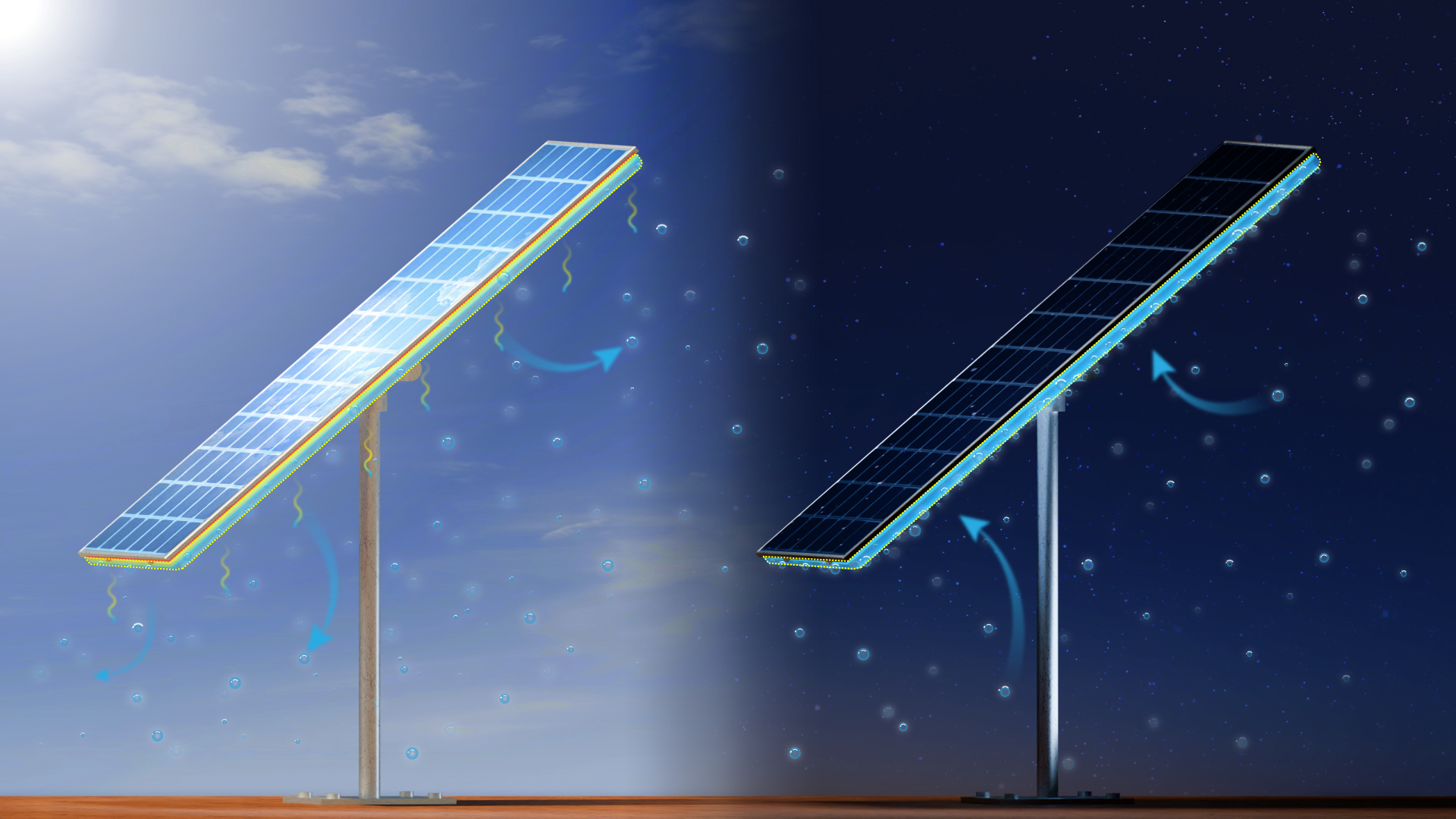
Led by Professor Qiaoqiang Gan, the KAUST team developed a novel nanomaterial that captures moisture from the air at night and releases it during the day. This evaporative cooling effect lowers the surface temperature of solar panels without requiring external energy. The composite film is ultrathin, inexpensive to produce, and compatible with existing photovoltaic architectures.
Testing in Saudi Arabia’s coastal deserts revealed that solar panels using this material produced more electricity and lasted longer than untreated panels. The technology reduced overall power generation costs by an impressive 18%, demonstrating not only technical merit but also commercial viability.
Field-Testing Across Continents
To ensure robustness, the material was also tested under rainy, cooler conditions in the mainland United States. The cooling layer performed effectively across these diverse environments, indicating its versatility for global deployment. The panels used in testing were provided by KAUST Professor Stefaan De Wolf, a leader in high-performance solar cell design, underscoring the high-tech context in which this material operates.
Beyond Solar Panels: Broad Applications in Photonics and LEDs
Dr. Abdullah AlMoqbel from KACST emphasized that the material has additional applications, including thermal regulation of high-power light emitters and laser systems—devices that traditionally suffer from heat-induced efficiency loss. Early studies suggest promising results in these areas, potentially unlocking broader energy and photonics markets.
Professor Abdulrahman AlBadri, Head of the National Center for Nanotechnology and Advanced Materials at KACST, noted that the research is directly aligned with Saudi Arabia’s Vision 2030 goals for energy independence and sustainability. With solar energy forming the backbone of the Kingdom’s renewable strategy, such innovations are key to ensuring long-term scalability and cost-effectiveness.
Toward a Cooler, Greener Future
This passive cooling material embodies the future of smart energy systems: low-cost, scalable, environmentally friendly, and easy to integrate. As solar power becomes more crucial worldwide, such materials will play a pivotal role in maximizing output while minimizing maintenance and operational expenses.
The work at KAUST, supported by national and international collaborators, is a strong reminder that the key to climate resilience may lie in the atomic architecture of engineered materials. With continued advancements in nanotechnology and materials science, solar energy is poised to shine brighter than ever.
🔗 Source: AZoCleantech – KAUST Researchers Develop Passive Cooling Composite Material for Solar Panels
Sponsored by PWmat (Lonxun Quantum) – a leading developer of GPU-accelerated materials simulation software for cutting-edge quantum, energy, and semiconductor research. Learn more about our solutions at: https://www.pwmat.com/en
📘 Download our latest company brochure to explore our software features, capabilities, and success stories: PWmat PDF Brochure

📞 Phone: +86 400-618-6006
📧 Email: support@pwmat.com
#SolarPanels #PassiveCooling #Nanomaterials #KAUST #GreenEnergy #SustainableTech #MaterialsScience #SolarInnovation #Photovoltaics #DesertTech #PWmat #CleanEnergy


Comments
Post a Comment