Revolutionizing 3D Printing: A Dual-Light Approach to Combining Soft and Hard Materials
By Quantum Server Networks
A team of researchers from the University of Texas at Austin has unveiled a groundbreaking 3D printing method that mimics nature’s ability to combine flexibility and strength in a single structure. Inspired by biological systems like bones and cartilage, this innovative approach allows for the fabrication of objects with both rigid and elastic components, paving the way for applications in prosthetics, soft robotics, and flexible electronics.
The Science Behind Dual-Light Printing
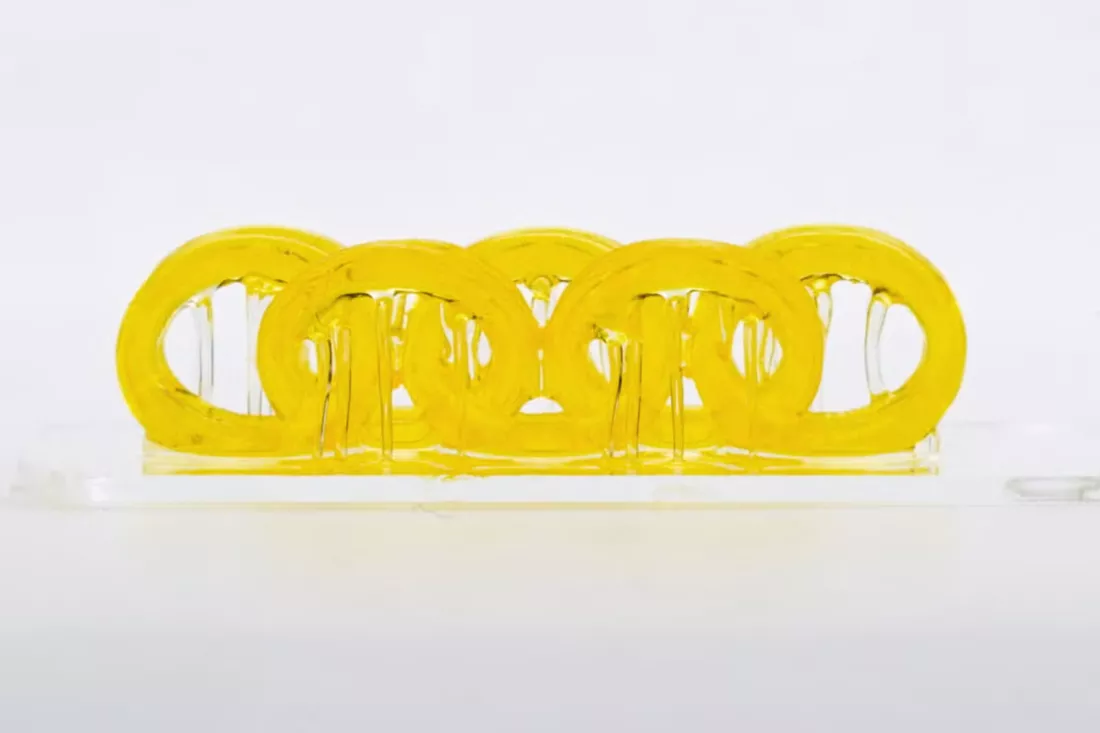
Unlike traditional 3D printing techniques that produce objects with uniform mechanical properties, this new method uses a specially formulated liquid resin and a dual-light process to achieve unprecedented control over material characteristics. The resin responds differently to two types of light: violet light produces soft, rubbery sections, while ultraviolet light solidifies the material into a tough, durable plastic.
This ability to dictate material properties within a single print is a significant leap forward. At the molecular level, the resin incorporates two reactive groups, allowing the solidification reactions triggered by different wavelengths to bond seamlessly. This ensures strong interfaces between soft and hard regions, preventing weak points that often lead to mechanical failure in composite structures.
Applications in Medicine, Robotics, and Electronics
The versatility of this technique opens the door to a wide range of innovations. The researchers demonstrated its potential by printing a model knee joint, where rigid “bones” and flexible “ligaments” worked together to mimic natural movement. They also fabricated stretchable electronics, embedding gold wires into soft sections that flex while maintaining protection in rigid zones.
Beyond its technical sophistication, the method is also accessible. The required equipment is simple and affordable, making it ideal for use in research labs, hospitals, and even educational environments. This democratization of advanced 3D printing could accelerate innovation in fields like custom medical devices, wearable sensors, and adaptive materials.
Looking Ahead
Supported by organizations including the US Department of Defense and the National Science Foundation, this dual-light 3D printing approach represents a critical step towards bio-inspired engineering. It holds promise for transforming how engineers and doctors design devices that demand both strength and flexibility—ushering in a new era of multifunctional materials.
Read the original article here: https://www.techspot.com/news/108510-new-dual-light-3d-printing-method-combines-soft.html
Sponsored by PWmat (Lonxun Quantum) – a leading developer of GPU-accelerated materials simulation software for cutting-edge quantum, energy, and semiconductor research. Learn more about our solutions at: https://www.pwmat.com/en
📘 Download our latest company brochure to explore our software features, capabilities, and success stories: PWmat PDF Brochure

📞 Phone: +86 400-618-6006
📧 Email: support@pwmat.com
#3DPrinting #MaterialsScience #DualLightPrinting #SoftRobotics #FlexibleElectronics #QuantumServerNetworks


Comments
Post a Comment