Diamond Capsules and the Future of High-Pressure Materials Research
In a groundbreaking study published in Nature Communications (https://www.nature.com/articles/s41467-025-61260-9), scientists have developed an innovative thin-film engineering approach that allows for the permanent encapsulation and preservation of high-pressure solids—such as gold nanoparticles—under ambient conditions. This technological leap paves the way for revolutionary developments in high-pressure physics, nanotechnology, and materials science.
Why High-Pressure Solids Matter
High pressure has long been known to induce transformative effects on the structure and properties of materials—turning graphite into diamond, for instance, or creating exotic superconductors. However, these effects have typically been limited to environments like diamond anvil cells (DACs), where extreme conditions must be maintained. Once the pressure is released, the materials revert to their original form, hindering real-world applications and atomic-scale studies.
The Breakthrough: Nanostructured Diamond Capsules (NDCs)
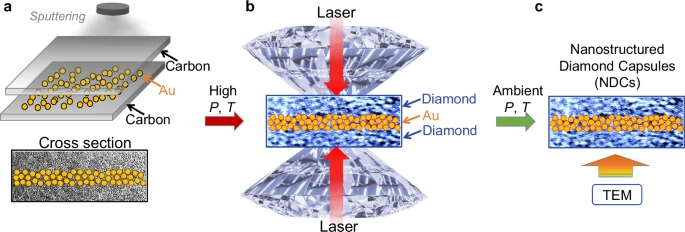
The research team led by Tao Liang, Zhidan Zeng, and Qiaoshi Zeng introduces a method that breaks this barrier. By creating a freestanding thin film composed of a carbon–gold nanoparticle–carbon (C-AuNPs-C) sandwich, and subjecting it to high pressures (up to 56 GPa) and temperatures (around 2200 K), the outer carbon layers convert into diamond, trapping the gold nanoparticles in a metastable high-pressure phase.
The encapsulated gold nanoparticles are compressed to pressures up to 26.2 GPa and remain stable even after returning to normal atmospheric conditions. These diamond capsules are fully compatible with high-resolution transmission electron microscopy (TEM), enabling in situ studies of materials once restricted to theoretical models.
Precision Engineering at the Nanoscale
The C-AuNPs-C thin films were fabricated using magnetron sputtering, allowing precise control over thickness and nanoparticle distribution. This control ensures the reproducibility and scalability of the approach—essential traits for potential industrial and academic applications. Furthermore, by tuning the synthesis pressure, researchers can fine-tune the internal stress within the encapsulated particles, allowing for engineered properties tailored to specific applications.
Implications and Future Applications
The successful preservation of solids in high-pressure states opens the door to a new class of functional nanomaterials. These could include catalysts, semiconductors, or magnetic materials with enhanced or entirely novel properties induced by pressure. Moreover, the transparent diamond shell of the capsules enables optical characterization and device integration, suggesting strong potential in optoelectronics, data storage, and quantum materials.
The study also hints at the broader applicability of this method beyond gold nanoparticles. With proper adaptation, similar encapsulation techniques could stabilize high-pressure phases of various elements and compounds, bringing us closer to room-temperature superconductors, superhard materials, and energy-dense storage systems.
Conclusion: A Platform for Discovery
This research not only solves a long-standing limitation in high-pressure materials science but also sets a new standard for what can be achieved using thin-film engineering at extreme conditions. The concept of nanostructured diamond capsules may soon become a foundational tool in the quest for next-generation materials with exceptional performance across physics, chemistry, and engineering domains.
For more in-depth insights, you can access the original article here: https://www.nature.com/articles/s41467-025-61260-9.
Sponsored by PWmat (Lonxun Quantum) – a leading developer of GPU-accelerated materials simulation software for cutting-edge quantum, energy, and semiconductor research. Learn more about our solutions at: https://www.pwmat.com/en
📘 Download our latest company brochure to explore our software features, capabilities, and success stories: PWmat PDF Brochure

📞 Phone: +86 400-618-6006
📧 Email: support@pwmat.com
#HighPressureMaterials #ThinFilmEngineering #Nanotechnology #DiamondCapsules #GoldNanoparticles #MaterialsScience #TEM #QuantumMaterials #PWmat #Nanostructures


Comments
Post a Comment