Rice University Unveils Quantum 'Super Material' That Could Transform Future Electronics
Published on Quantum Server Networks • June 2025 • Breakthroughs in Quantum Materials and Electronics
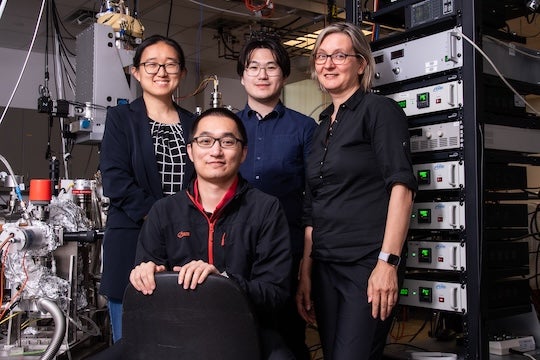
In a stunning advancement that could usher in a new era of ultra-efficient electronics, a collaborative research team led by physicists Ming Yi and Emilia Morosan at Rice University has discovered a new class of material known as a Kramers nodal line metal. This quantum material exhibits unique symmetry-protected electronic properties and could potentially be harnessed for next-generation superconductors and topological devices.
Source: Rice University News Release
What Is a Kramers Nodal Line Metal?
The team achieved this feat by subtly doping tantalum disulfide (TaS₂) with small amounts of indium. This structural tweak alters the crystal’s symmetry, creating a material where spin-up and spin-down electrons travel on separate pathways in momentum space. These distinct routes converge at a Kramers nodal line—an exotic topological feature that protects the unique electronic behavior from degradation.
Think of this as building a highway with perfectly separated lanes for vehicles traveling in opposite directions—no crashes, no interference, just streamlined performance. And in the case of electrons, that translates to low-loss, high-efficiency electrical conduction.
Dual Identity: Topological and Superconducting
What makes this discovery even more extraordinary is that the material not only features the topologically protected Kramers nodal line but also shows signs of superconductivity. These two characteristics combined make the material a prime candidate for use in topological superconductors—exotic systems that can carry electrical current without energy loss and with inherent resistance to quantum decoherence, ideal for applications in quantum computing and secure communication technologies.
From Discovery to Design: Experimental Precision Meets Theory
The team used advanced tools such as spin-resolved angle-resolved photoemission spectroscopy (ARPES) and magneto-electrical transport measurements to track the behavior of electrons with atomic precision. The experimental data was then supported by theoretical modeling based on first-principles calculations, which confirmed the topological nature of the material's band structure.
“Our experiments indicate that we can precisely adjust the material’s properties to accentuate its topological traits, which is vital for future applications,” said Yichen Zhang, a Rice doctoral student and co-first author of the study.
A Model of Collaborative Innovation
The research, published in Nature Communications on May 29, 2025, is the result of a global collaboration involving institutions such as the University of California Berkeley, SLAC National Accelerator Laboratory, Brookhaven National Lab, Hong Kong University of Science and Technology, and the University of British Columbia.
“This groundbreaking work exemplifies the spirit of innovation that defines the Smalley-Curl Institute,” said co-author Junichiro Kono. “It advances our mission to foster cross-disciplinary collaboration across physics, engineering, and materials science.”
Why It Matters: Toward a Low-Energy Future
Electronics are the backbone of our digital world, but they come with enormous energy costs. As transistors reach atomic limits and data centers consume increasing amounts of electricity, materials like this could change the game. The ability to build low-energy-loss, topologically protected circuits could revolutionize everything from mobile devices to artificial intelligence hardware and quantum networks.
“There is still much to explore,” said doctoral student Yuxiang Gao. “But this discovery offers a solid stepping stone toward devices that are not only more powerful but also far more sustainable.”
For more technical details, see the original publication: “Tuning Symmetry and Topology in Indium-Substituted Tantalum Disulfide for Kramers Nodal Line Electronic Properties,” Nature Communications, May 2025.
#QuantumMaterials #TopologicalSuperconductors #LowEnergyElectronics #RiceUniversity #KramersNodalLine #CondensedMatterPhysics #Superconductivity #ARPES #NextGenElectronics #QuantumServerNetworks


Comments
Post a Comment