Perovskite-Silicon Tandem Solar Cells Reach 27.8% Efficiency with Hybrid Blade-Coating Breakthrough
Published on Quantum Server Networks
In a groundbreaking collaboration between King Abdullah University of Science and Technology (KAUST) in Saudi Arabia and Germany’s Fraunhofer Institute for Solar Energy Systems (Fraunhofer ISE), researchers have developed a high-efficiency perovskite-silicon tandem solar cell using an innovative two-step hybrid deposition process. This pioneering method achieved an impressive 27.8% power conversion efficiency and an open-circuit voltage of 1.9 V—marking a new milestone in scalable solar technology.
The full article was published by PV Magazine, highlighting how the integration of hybrid evaporated/blade-coating techniques could lead the way to mass-manufacturable, highly efficient tandem solar modules.
The Science Behind the Coating
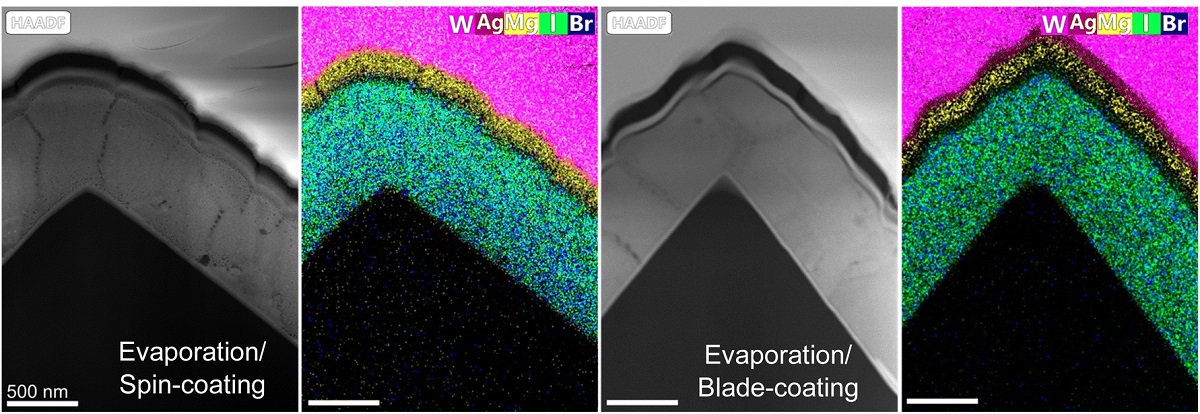
The researchers combined evaporation and blade-coating techniques—traditionally used separately—to develop a scalable deposition process. By analyzing the interplay between solvent evaporation rates and blade speed (via the Landau–Levich model), they discovered precise conditions that ensure the successful formation of high-quality perovskite films.
The findings showed that when the coating speed is properly balanced with the evaporation rate, the resulting wet film enables complete infiltration of organic precursors, leading to an efficient conversion into the perovskite’s photoactive phase. This insight is critical for maintaining performance while transitioning from lab-scale to large-area devices.
Efficiency with Less Material
One of the key advantages of this hybrid method is its material efficiency. The research team reported that the new process required up to eight times less solution volume than the traditional hybrid evaporation/spin-coating approach. This not only reduces costs but also supports sustainability efforts by minimizing waste.
They also successfully integrated crystallization additives into the blade-coating process—previously used only in spin-coating—without requiring any change to annealing conditions or additive concentrations. This breakthrough further supports the scalability of the technique.
Outdoor Stability Testing
The team conducted one of the first real-world outdoor stability tests of scalable tandem cells using industry-standard silicon bottom cells with texturing. While the results showed potential, they also revealed a need for improved perovskite layer robustness. To address this, researchers plan future work on compositional engineering and interfacial passivation to reduce defect-related losses and improve long-term durability.
Implications and Future Directions
With this success, the research lays the groundwork for further exploration into slot-die coating, inkjet printing, and spray-coating for even broader industrial application. As the field pushes toward scalable and cost-effective perovskite-silicon tandem solar technologies, innovations like this one are vital to closing the gap between lab performance and market viability.
As Juliane Borchert, group leader at Fraunhofer ISE, noted, “The dynamics we’ve identified here are not limited to blade-coating—they could revolutionize how we design scalable perovskite devices across the board.”
Conclusion
This collaborative breakthrough marks a turning point in the development of tandem solar cells. The hybrid blade-coating technique demonstrates not only high efficiency but also scalable potential—paving the way for commercial applications in the clean energy landscape of tomorrow.
Read the full article on PV Magazine: Click here.
Stay connected with Quantum Server Networks for the latest in solar materials science and renewable energy breakthroughs.
#PerovskiteSolarCells #TandemSolar #SolarEnergy #HybridBladeCoating #KAUST #FraunhoferISE #Photovoltaics #RenewableEnergy #MaterialsScience #QuantumServerNetworks #ScalableSolarTech #CleanEnergyFuture


Comments
Post a Comment