Breaking Efficiency Records: Perovskite–Organic Tandem Solar Cells Reach 26.4% Power Conversion
Published on Quantum Server Networks | June 27, 2025
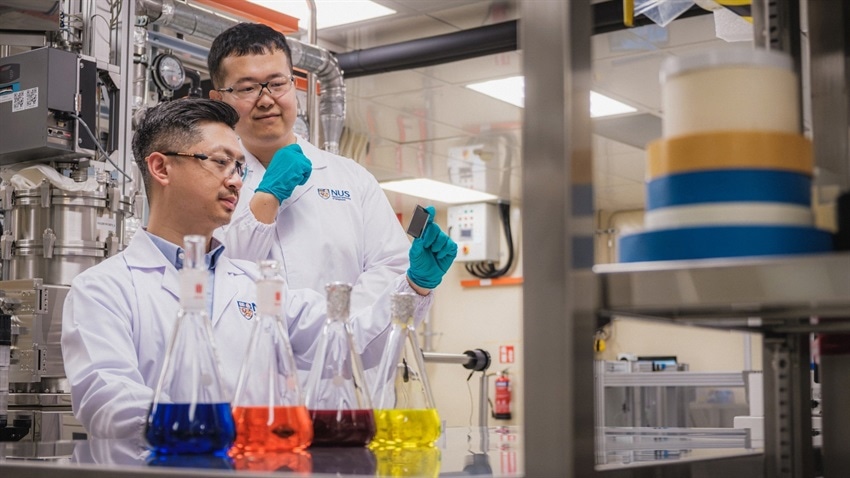
In a major breakthrough for sustainable energy technologies, researchers at the National University of Singapore (NUS) have achieved a certified 26.4% power conversion efficiency for perovskite–organic tandem solar cells. This achievement, recently published in Nature, sets a new global benchmark for this type of thin-film photovoltaic device and moves us a step closer to realizing flexible, lightweight, and highly efficient solar energy systems.
Why Tandem Solar Cells Matter
Tandem solar cells combine two or more semiconducting layers with complementary absorption properties. In this case, the team paired a high-efficiency perovskite top cell with a newly designed narrow-bandgap organic absorber that excels at harvesting near-infrared (NIR) photons—a region traditionally difficult to capture efficiently in thin-film technologies.
These NIR-sensitive layers significantly broaden the solar spectrum that can be harvested, improving energy conversion and minimizing losses from unabsorbed light.
Technical Highlights of the Breakthrough
- Narrow-Bandgap Organic Absorber: The key innovation is a novel asymmetric organic acceptor with extended conjugation, enabling deep NIR absorption without compromising charge separation efficiency.
- Efficient Charge Extraction: Ultrafast spectroscopy confirmed minimized energy losses and high free carrier collection.
- Certified Performance: The tandem device achieved 27.5% efficiency in small-scale (0.05 cm²) samples and 26.7% in 1 cm² cells, with a third-party certified 26.4% efficiency—one of the highest reported among perovskite–organic systems.
- Transparent Conducting Oxide Interconnect: The two layers are joined via a transparent oxide interface, ensuring optical transparency and electronic conductivity for tandem performance.
Why This Matters for Real-World Applications
According to lead researcher Assistant Professor Hou Yi, these flexible solar films are not only efficient but also ideally suited for applications in emerging sectors such as:
- Drones
- Wearable electronics and health sensors
- Smart fabrics and AI-powered textiles
With potential to exceed 30% efficiency, this technology could soon enable self-powered, roll-to-roll printable electronics that conform to curved surfaces or clothing—a futuristic vision rapidly becoming reality.
Next Steps and Industry Implications
The NUS team now aims to enhance the long-term operational stability of these devices and initiate pilot-line manufacturing under real-world conditions. Achieving scalable production and durability will be key to commercial viability.
This research is a major milestone toward solar energy systems that are not only efficient but also portable, adaptable, and integrated into everyday materials.
Research Citation
Read the original article: AZoM News Report
Journal Reference: Jia, Z., et al. (2025). Efficient near-infrared harvesting in perovskite–organic tandem solar cells. Nature. https://www.nature.com/articles/s41586-025-09181-x
Conclusion
Flexible, lightweight, and record-setting efficient, perovskite–organic tandem solar cells are at the forefront of next-gen photovoltaics. As fabrication techniques improve and device lifetimes increase, we may soon see a solar-powered revolution in textiles, wearables, and smart technologies.
Follow Quantum Server Networks for more insights into advanced solar materials, photonic devices, and semiconductor innovation.
Sponsored by PWmat (Lonxun Quantum) – a leading developer of GPU-accelerated materials simulation software for cutting-edge quantum, energy, and semiconductor research. Learn more about our solutions at: https://www.pwmat.com/en
📘 Download our latest company brochure to explore our software features, capabilities, and success stories: PWmat PDF Brochure

📞 Phone: +86 400-618-6006
📧 Email: support@pwmat.com


Comments
Post a Comment