MIT Discovers a Superconducting Magnet: A Chiral Breakthrough in Graphene Physics
Superconductors and magnets have long been considered incompatible—until now. In a remarkable discovery published in Nature, researchers at MIT have identified a material that defies this dogma: a “chiral superconductor” that conducts electricity with zero resistance and exhibits intrinsic magnetic behavior.
What’s even more astonishing? This exotic quantum phase has been found in a seemingly mundane material—graphite, the same substance in your pencil lead. The MIT team demonstrated that when graphene layers are stacked in a special “rhombohedral” pattern, they exhibit superconductivity and magnetism—simultaneously.
Graphene’s Chiral Surprise
Graphite is composed of millions of stacked graphene sheets. Occasionally, these layers deviate from their typical alignment, forming a staircase-like structure called rhombohedral stacking. The MIT team focused on isolating and testing five-layer rhombohedral graphene structures placed on hexagonal boron nitride substrates.
At ultracold temperatures (~300 millikelvins), they observed that electrical current passed through the material without any resistance—a hallmark of superconductivity. But then came the twist: applying a magnetic field caused the material to switch between two superconducting states, a behavior akin to a magnetic hysteresis loop.
“This is the first time we’ve observed a superconductor that also acts like a magnet with such direct evidence,” said Prof. Long Ju, senior author of the study. “It’s a completely counterintuitive phenomenon.”
From Cooper Pairs to Orbital Magnetism
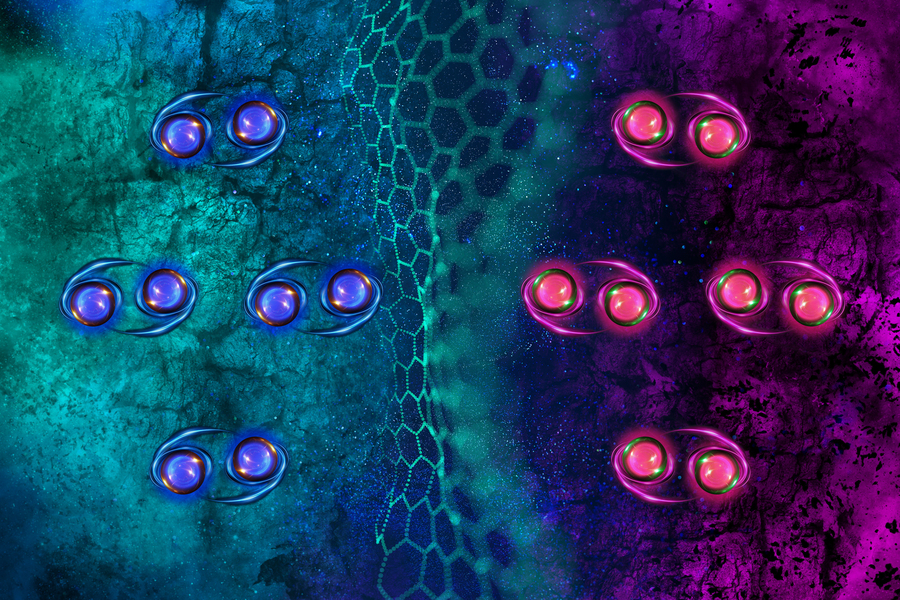
In conventional superconductors, Cooper pairs of electrons form and flow without resistance. They typically cancel each other’s momentum, producing zero net magnetic effect. In contrast, the MIT researchers propose that in their graphene configuration, electrons pair while occupying the same momentum “valley,” producing a superconducting state with built-in orbital angular momentum.
This type of material is now being classified as a chiral superconductor—one that breaks time-reversal symmetry and may carry quantized angular momentum. Such states are not just novel but may also serve as topological superconductors, offering fault-tolerant platforms for quantum computing.
Implications and Future Research
Key discoveries from the study include:
- ⚛️ Discovery of magnetic superconductivity in a simple carbon-based system
- 🌀 Identification of a chiral superconducting state through magnetic field response and resistance switching
- 🔍 Potential use as a platform for topological qubits in robust quantum information systems
“Everything we’ve found in this material has been unexpected,” said Dr. Zhengguang Lu, now at Florida State University. “But because it’s a simple system, we think we can unravel the deep physics involved.”
The team’s discovery paves the way for broader exploration of exotic phases in layered materials—and could eventually redefine what we expect from superconductors in electronic and quantum applications.
🔗 Original article citation: MIT News – MIT physicists discover new type of superconductor that is also a magnet (May 22, 2025)
📣 Promote Your Scientific Innovations Effectively
Are you leading research in quantum materials, condensed matter, or applied physics? Let QSComputing help you communicate your breakthroughs to the world with expert scientific social media marketing and communication services.
📎 Discover our consultancy offerings
💬 Sponsored ad space is also available within this blog. Fully flexible formats and pricing—contact us to feature your innovation here!


Comments
Post a Comment