Additive Manufacturing Meets Acoustics: Redesigning Sound Absorption with 3D-Printed Metamaterials
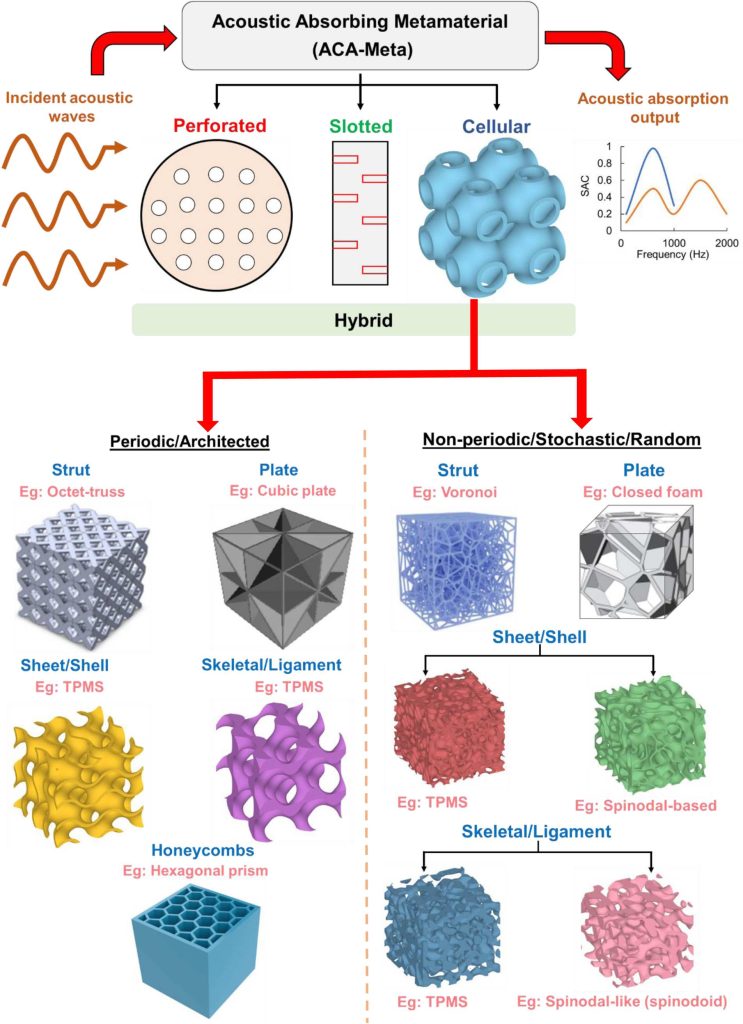
Acoustic design is undergoing a silent revolution—powered by the precision and adaptability of additive manufacturing. A comprehensive review published in Virtual and Physical Prototyping by researchers from Khalifa University and Dassault Aviation explores how 3D printing technologies are redefining the landscape of engineered acoustic metamaterials.
These additively manufactured acoustic metamaterials (ACA-Meta) are tailored to absorb, manipulate, and redirect sound waves across broad frequency ranges using structural designs previously unachievable with traditional manufacturing techniques.
Redefining Sound Control with Geometry
Traditional sound absorbers like foam panels and fibrous materials suffer from fixed properties and limited frequency response. In contrast, ACA-Meta devices leverage sub-wavelength precision geometries to fine-tune their acoustic behavior. Through 3D printing methods such as SLA, FDM, SLM, DLP, and others, researchers can fabricate complex internal architectures—resonant cavities, gradient porosities, and coiled channels—that drastically enhance acoustic performance.
These metamaterials are classified into four main structural families:
- 🔹 Perforated types: Feature micro-holes backed by air cavities, ideal for mid-to-high frequency absorption
- 🔸 Slotted types: Use labyrinthine paths to trap low-frequency sound in compact forms
- 🔹 Cellular types: Include gyroids, honeycombs, and stochastic foams for broadband control
- 🔸 Hybrid designs: Combine multiple strategies for multi-regime, tunable acoustic performance
Even minor tweaks—like adjusting perforation angles or layering cell densities—can shift absorption coefficients, proving the power of digital fabrication in acoustic engineering.
From Theory to Performance
The paper emphasizes the crucial role of simulation and experimental validation. Using impedance tubes and reverberation chambers, researchers have confirmed that many ACA-Meta designs match or exceed traditional materials in sound absorption coefficient (SAC) performance—especially when parameters like wall thickness, pore size, and infill density are optimized through iterative printing and testing.
Next Steps: 4D and Multi-Material Acoustic Systems
Looking forward, the review highlights future directions such as:
- 🧩 Volumetric 3D printing for embedding tunable response zones
- 🔀 Multi-material printing to layer acoustic and mechanical properties
- 🌀 4D printing using smart polymers for real-time acoustic reconfiguration
Such advances could yield smart sound absorbers capable of dynamically adjusting to environmental stimuli, with applications in architecture, aerospace, defense, and consumer electronics.
Acoustic Metamaterials in the Real World
The possibilities aren’t theoretical. Campfire Audio, for example, has used 3D printing to optimize internal acoustic structures for high-end earphones. Meanwhile, researchers at the University of Sussex and Strathclyde are pioneering directional audio and miniaturized acoustic sensors using printed metamaterials. A recent innovation—holographic Direct Sound Printing (DSP)—even uses sound itself as a fabrication tool, blurring the line between medium and mechanism.
This convergence of additive manufacturing and sound engineering is poised to produce a new generation of acoustic devices that are not just quieter—but smarter, lighter, and more adaptable than anything before.
🔗 Original article citation: 3D Printing Industry – Additive manufacturing unlocks new possibilities in acoustic metamaterials design (May 2025)
📘 Full review available in: Virtual and Physical Prototyping – Taylor & Francis Online
🎯 Maximize Impact for Your Additive Acoustics Innovations
Are you developing cutting-edge acoustic metamaterials or 3D-printed technologies? Let QSComputing help you share your breakthroughs through specialized scientific marketing, digital engagement strategy, and global visibility campaigns.
🔗 Discover our consultancy services
📣 Sponsored content space is available within this blog for companies and research labs—featuring flexible formats and negotiable pricing tailored to your needs.


Comments
Post a Comment