Breakthrough in Hydrogen Catalysts: New Tungsten-Based MXene Unlocks Greener Energy Future
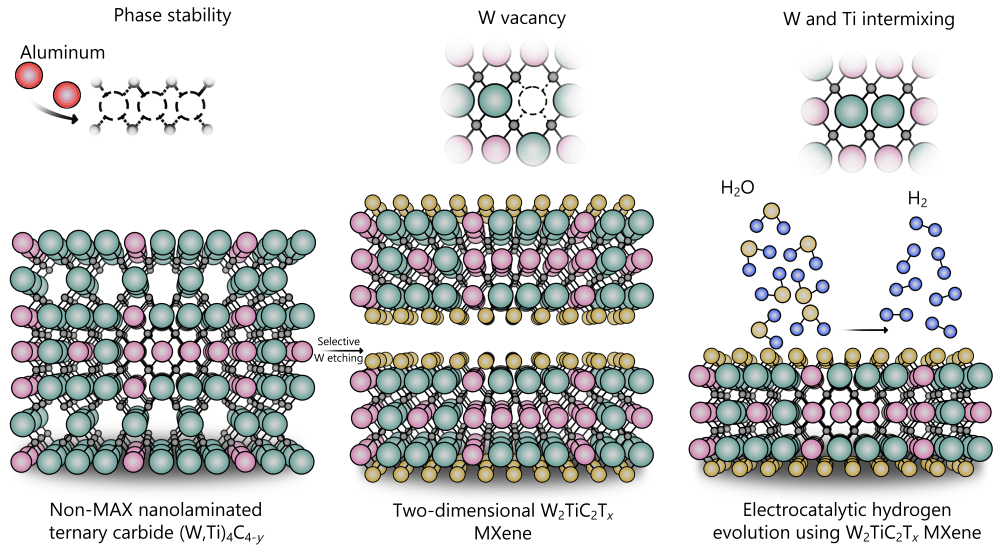
The global race toward a sustainable hydrogen economy just took a major leap forward with the successful synthesis of a new tungsten-based MXene—a revolutionary 2D material with game-changing implications for clean energy production.
In a March 2025 study published in Nature Synthesis, researchers led by Babak Anasori at Purdue University reported the first-ever creation of a layered tungsten-based MXene, potentially paving the way for more cost-effective and environmentally friendly hydrogen production technologies.
Why Hydrogen Matters
Hydrogen is a clean fuel that, when used in a fuel cell, emits only water. Yet, producing hydrogen cleanly remains a challenge. Current methods like electrolysis—splitting water into hydrogen and oxygen using electricity—require expensive platinum-based catalysts to achieve high efficiency.
This new discovery could disrupt that paradigm. By developing an alternative catalyst based on tungsten—a more abundant and affordable metal than platinum—scientists have opened the door to greener hydrogen production on a global scale.
MXenes: The Future of 2D Materials
MXenes are a family of two-dimensional transition metal carbides, nitrides, or carbonitrides known for their excellent electrical conductivity, hydrophilicity, and large surface areas. They’re already being studied for uses in energy storage, sensors, electromagnetic shielding, and catalysis.
Until now, synthesizing tungsten-based MXenes was considered nearly impossible due to the instability of traditional tungsten-containing MAX phase precursors. Anasori’s team bypassed this challenge by etching a non-MAX nanolaminated ternary carbide precursor—a novel approach that finally unlocked tungsten’s potential in 2D form.
A Catalyst Rivaling Platinum
The resulting MXene, with the composition W2TiC2Tx, demonstrated a hydrogen evolution reaction (HER) overpotential of only ~144 mV—roughly 25% lower than the previous best MXene catalyst and edging closer to platinum’s industry-leading performance (~20–40 mV).
Its performance metrics also include a low Tafel slope, indicating fast catalytic kinetics, and stability in acidic environments for over 24 hours. These properties make it a strong candidate for integration into scalable water-splitting systems for green hydrogen generation.
Beyond Hydrogen: Toward Optoelectronic Applications
Excitingly, this tungsten-based MXene may also find applications in electronics and photonics. Early analysis revealed promising optoelectronic behavior, with potential uses in optical limiting and all-optical switching—key technologies for future photonic circuits and quantum devices.
What’s Next?
This breakthrough could accelerate the shift to a hydrogen-powered future while reducing dependency on rare precious metals. Furthermore, the novel synthesis method used here may lead to a wider library of non-MAX-based MXenes, offering researchers a new toolbox for designing next-generation 2D materials.
As nations invest billions into hydrogen infrastructure and green technologies, discoveries like these are critical. With affordable catalysts made from earth-abundant materials, the dream of clean, sustainable hydrogen energy may soon become a reality.
📄 Read the full article here: Novel MXene synthesis creates cost-effective hydrogen catalyst (Ceramic Tech Today)
Published by Quantum Server Networks – delivering cutting-edge insights into materials science, nanotechnology, and the computational revolution behind next-gen innovations.


Comments
Post a Comment